Postgres as the AI Vector Store: Why SQL Beats NewDBs
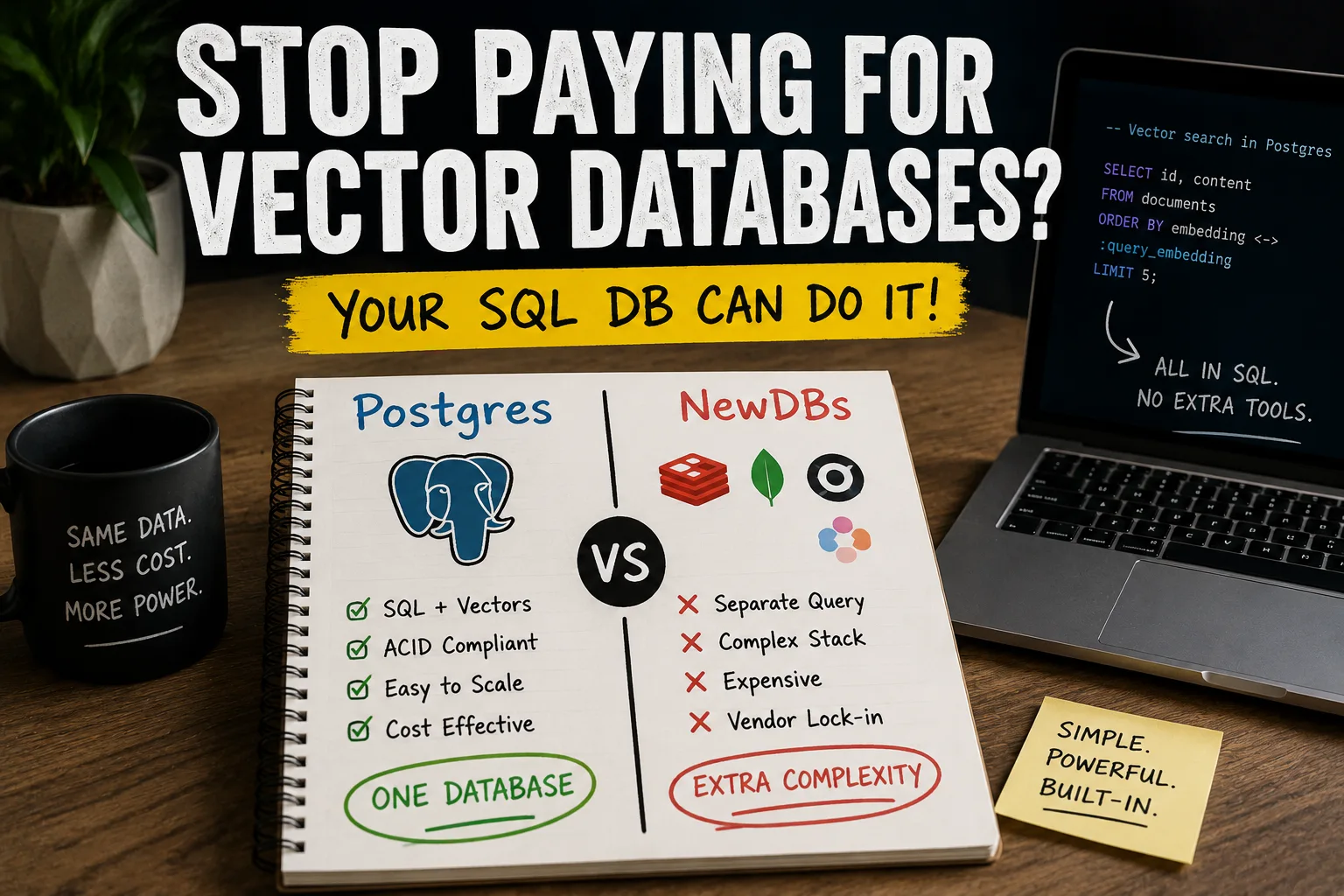
The Great Shift: Why Developers Are Abandoning Standalone Vector Databases
The Rise and Fall of the 'Specialized' Vector DB Boom
The initial hype cycle around vector databases was loud and fast. Pinecone, Milvus, and Weaviate became the default choice for RAG implementations. Engineers grabbed these tools to solve embedding storage problems quickly. The promise was simple: drop vectors in, get relevance out. This speed appealed to teams under pressure to ship AI features.
Reddit communities began exposing a different reality. Threads titled "Why vector databases are a scam" gained traction. Users cited opaque pricing models that hurt budgets. One post highlighted $800 initial costs and $20-$200 monthly variance for Pinecone. The variance made cost forecasting impossible for startups. Vendor lock-in became the second major complaint.
Data movement is difficult once you are inside a black box. Migrating embeddings to a new provider requires re-indexing. This process halts service and burns engineering hours. The narrative shifted from "speed" to "risk." Teams realized they had traded one problem for another.
The market is responding to these risks. 80% of new database instances in 2026 are provisioned by AI agents. These agents prefer standard SQL interfaces. They avoid complex proprietary APIs. This trend favors databases with open standards.
The 'State of Databases 2026' report confirms this shift. PostgreSQL is the most used and admired database for the second year running. Engineers trust what they know. They avoid the uncertainty of new specialized stores. The report highlights a clear preference for stability over novelty.
Consolidation signals the end of the fragmented era. Databricks acquired Neon for $1B. Snowflake acquired Crunchy Data for $250M. These moves consolidate the stack. They reduce the need for standalone vector providers. The market is shrinking toward a few reliable platforms.
The Complexity Trap: Managing Multiple Data Silos
Separate infrastructure creates operational overhead. Maintaining relational data, caching layers, and vector embeddings is hard. Each component requires its own monitoring and scaling. DevOps teams spend hours on configuration drift. This burden slows down feature development.
Fragmented data architectures complicate consistency. Transactional integrity is difficult across systems. Updates in one store do not automatically reflect in another. Data integrity checks become manual processes. Engineers write scripts to verify synchronization. These scripts often fail in production.
Relationships between datasets are hard to maintain. Vector data is often isolated from relational schemas. Linking an embedding to its source record requires external logic. Queries become complex joins across network boundaries. Latency increases with each hop. The system slows down as data grows.
Keeping data in sync is a nightmare. Updating vectors when underlying content changes is slow. You must invalidate, recalculate, and reindex. This process introduces lag and errors. The 'New Stack' quote highlights this issue. People do not realize they must manage sync logic.
The common stack illustrates the burden. Postgres + Redis + Pinecone + Elasticsearch is heavy. Each component adds a failure point. Scaling one does not scale the others evenly. Engineers spend more time managing the stack than building features.
Schema management differs across systems. SQL schema versions are standard and clear. Proprietary vector index versions are opaque. Tracking changes in a black box is risky. Auditing becomes a manual, error-prone task. The cost of complexity outweighs the benefit of specialization.
The PostgreSQL Renaissance: A Unified Storage Engine
PostgreSQL is a flexible platform for AI workloads. It is not just a relational database. Extensions like pgvector make it suitable for embeddings. The 'PostgreSQL Renaissance' is driven by maturation. Engineers are adopting extensions for production use.
SQL capabilities are critical for filtering. Joins and foreign keys contextualize vector search results. You can filter vectors by metadata easily. This avoids complex external filtering logic. The database handles the heavy lifting.
The 'SQL as the new API' concept is gaining ground. AI agents query databases programmatically. This allows for direct provisioning and querying. Agents can read and write data directly. This reduces the need for API gateways. The database becomes the single source of truth.
OpenAI scales 800 million ChatGPT users on a single PostgreSQL primary instance. This example proves SQL can handle massive scale. The infrastructure is proven and reliable. Engineers trust the underlying engine.
Math-heavy AI is embedded in the database. The 'mystical robot overlord' AI is fading. Practical, vector-based reasoning is taking over. This shift aligns with SQL strengths. Engineers can use standard queries for AI tasks.
Extensions like SurrealDB 3.0 mirror Postgres's extensibility. Graph, vector, and relational capabilities are unified. This approach simplifies the architecture. You do not need separate tools for different data types. The database handles all relationships.
The industry is moving toward unified architectures. Fragmented, specialized vector databases are losing ground. PostgreSQL simplifies management and reduces costs. It leverages existing SQL skills effectively. This shift is practical and measurable.
Understanding the Tech: Vectors, Embeddings, and pgvector Mechanics
Demystifying Vectors: The 'School of Fish' Analogy
An embedding maps semantic meaning into a coordinate system using a list of numbers. Think of a high-dimensional space where each axis represents a specific trait. A vector places an object within this space based on its attributes.
Consider a school of fish swimming in a pond. The fish move together because of proximity and shared behavior. A vector captures this context, not just a static label like "fish." It records position, speed, and relationship to neighbors.
AI is math, not magic. Vectors represent that context numerically. Systems find similar items by measuring distance in this space. The closer two points are, the more similar their meaning.
This differs from sparse vectors, which rely on keyword matches. Sparse vectors look for exact string matches. Dense vectors look for conceptual similarity. A search for "dog" finds "puppy" in dense search, but not in sparse.
Imagine a Cartesian plot with X and Y axes. Now extend that to hundreds of dimensions. A point for "fish" captures species, fin shape, and nearby schools. A simple string tag misses these nuances entirely.
As noted in a pgEdge blog post, a vector represents more than the species. It captures everything about the fish in its context. This allows for nuanced retrieval based on meaning rather than keywords.
How pgvector Extends PostgreSQL for AI Workloads
pgvector is an extension that adds vector capabilities directly to PostgreSQL. It treats the database as a first-class citizen for AI workloads. You store vectors as arrays within standard SQL tables.
The system uses specific indexing algorithms for fast retrieval. HNSW (Hierarchical Navigable Small World) builds a multi-layer graph. IVFFlat uses inverted file lists for faster approximate search.
Distance metrics determine how similarity is calculated. Cosine distance measures the angle between vectors. L2 distance measures the straight-line distance. Inner product measures the magnitude and alignment.
pgvector matches the performance of standalone vector databases for many tasks. It avoids the overhead of separate services. You can run queries using standard SQL syntax.
PostgreSQL supports the vector data type with up to 2000 dimensions. This fits most modern embedding models. You define the type in your schema definition.
The <-> operator calculates L2 distance in SQL queries. The <#> operator calculates inner product. These operators integrate directly into the query planner.
CREATE TABLE items (
    id SERIAL PRIMARY KEY,
    content TEXT,
    embedding VECTOR(1536)
);

INSERT INTO items (content, embedding)
VALUES ('A cat sitting on a mat', '[0.1, 0.2, ...]');

SELECT id, content
FROM items
ORDER BY embedding <-> '[0.1, 0.2, ...]'::vector
LIMIT 5;
The first command creates a table with a vector column. The second inserts data with a 1536-dimensional embedding. The third query finds the closest items by distance. This runs entirely within PostgreSQL.
The Evolution of Vector Search in PostgreSQL
Recent pgvector releases have improved ANN algorithms. Developers added support for HNSW index parameters like m and ef_construction. These allow tuning for speed versus accuracy.
Parallelization improvements in PostgreSQL 15 and 16 help large scans. The query planner now handles hybrid searches better. You can combine vector similarity with traditional SQL filters.
This matters for production systems. You often need to filter by metadata before searching vectors. The planner optimizes this combined operation efficiently.
The PostgreSQL community drives these AI-specific enhancements. Contributors submit patches for distance metrics and vector types. Half-precision floats improve storage efficiency in recent updates.
Foreign key support in vector queries is a key advantage. Many standalone vector databases lack this relational integrity. You can link vectors to other tables in Postgres.
This eliminates the need for a separate vector-specific database. You keep data in one system. The query planner handles the complexity.
pgvector makes PostgreSQL a practical vector store. It uses familiar SQL syntax and efficient indexing. This removes the burden of managing separate infrastructure.
Architectural Advantages: Why SQL Wins for AI Data Management
The Power of Hybrid Search: SQL + Vector Similarity
Vector similarity alone rarely delivers the precision required for production applications. A semantic search might return relevant text, but it lacks the rigid constraints needed for filtering. You often need to restrict results by date, user ID, or category.
PostgreSQL combines these needs in a single query. You can run a vector similarity search while applying standard SQL filters. This reduces the candidate set before the expensive vector calculation runs.
Most standalone vector databases struggle with this. They treat metadata as opaque blobs. Filtering on that data often requires pulling everything into memory. This kills latency and increases cost.
Hybrid search keeps the filter tight and the vector index efficient.
Consider a RAG pipeline retrieving health documents. You need recent articles from a specific category. A pure vector store might return old or irrelevant entries. You then have to post-filter in application code.
Postgres handles this natively. The query engine applies the WHERE clause first. It narrows the candidate set. The vector operator then ranks the remaining items.
SELECT id, title, content
FROM documents
WHERE category = 'health'
  AND created_at > '2023-01-01'
ORDER BY embedding <-> vector '[0.1, 0.2, ...]'
LIMIT 10;
This query filters by category and date. It then sorts by vector similarity. The database uses the index for the vector part. It uses the B-tree for the metadata part.
Standalone vector databases like early Pinecone versions lack this flexibility. They require external stores for complex metadata. You must sync two systems. This introduces latency and failure points.
The 'impossible' nature of joins in vector-only stores is real. You cannot link a vector to its source document easily. You rely on opaque IDs. Postgres lets you join vectors to relational data.
Hybrid search is critical for RAG accuracy.
Factual accuracy depends on precise retrieval. If you retrieve the wrong document, the LLM hallucinates. SQL filters ensure you get the right context. This reduces noise in the final response.
The latency benefit is immediate. Filtering before vector search reduces the number of distance calculations. Fewer calculations mean faster responses. This matters for real-time applications.
You avoid the external sync problem. Standalone DBs often require complex ETL pipelines. Postgres keeps data in one place. You query it directly.
Data Integrity and Relational Joins in AI Pipelines
Vector embeddings are not self-contained. They point to source data. That source data changes. Text updates. Metadata shifts. Access rights rotate.
Foreign keys enforce this relationship. They link the vector to the document. They link the document to the user. This structure prevents orphaned data.
Orphaned vectors waste storage. They also confuse retrieval. A vector pointing to deleted text returns nothing useful. You must clean up manually.
PostgreSQL's ACID compliance solves this. Transactions ensure consistency. You update text and vector in one step.
import psycopg2

conn = psycopg2.connect("dbname=test user=postgres")
cur = conn.cursor()

try:
    cur.execute("BEGIN")
    cur.execute(
         "UPDATE documents SET content = %s WHERE id = %s",
         ("New content", 123)
     )
    cur.execute(
         "UPDATE document_vectors SET embedding = %s WHERE doc_id = %s",
         ([0.1, 0.2], 123)
     )
    cur.execute("COMMIT")
except Exception as e:
    cur.execute("ROLLBACK")
    raise e
finally:
    cur.close()
    conn.close()
This code updates text and vector atomically. If either fails, the other reverts. No partial updates occur.
The nightmare of keeping Pinecone vectors in sync is real. You must listen to change data capture streams. You must write sync logic. You must handle failures.
Postgres eliminates this overhead. The vector lives next to the text. Updates are local. Consistency is guaranteed.
Relational joins allow complex queries. You can span multiple data types. Text, metadata, and relationships coexist.
Foreign keys prevent data drift.
In a RAG pipeline, access control is vital. You must check user permissions. SQL joins let you filter by user ID. Standalone DBs often lack this.
You risk exposing sensitive data. A vector search might return restricted documents. Postgres enforces permissions via SQL. This adds a security layer.
Transactions ensure vector updates and document updates happen atomically. You do not need external orchestration. The database handles it.
This reduces operational risk. Fewer moving parts mean fewer failures. You trust the database engine. You do not trust custom sync scripts.
Simplified Stack: One Database to Rule Them All
DevOps overhead kills velocity. Monitoring multiple services drains resources. Each service has its own backup strategy. Each service has its own security model.
Postgres unifies this. It handles relational data. It handles vector search. It handles JSON.
A unified stack reduces cognitive load.
You replace Postgres + Redis + Pinecone + Elasticsearch. You keep only Postgres. The toolset shrinks. The skill set narrows.
Cost benefits are immediate. You pay for one license. You pay for one infrastructure layer. You avoid data egress fees between services.
The trend of 'AI agents' creating databases favors standard SQL. Agents write SQL easily. They struggle with proprietary APIs.
Standard SQL interfaces are universal. Any agent can query Postgres. Proprietary vector DBs require specific SDKs.
Simplification drives adoption.
You use standard SQL tools for everything. pgAdmin or DBeaver works for vectors. You do not need a separate vector UI.
The 'State of Databases 2026' report notes absorption of vector DBs. Larger platforms integrate vector capabilities. This mirrors Postgres's approach.
You avoid the silo problem. Data stays in one place. Queries stay in one place. Analytics stays in one place.
The ease of using standard SQL tools is underrated. Engineers know SQL. They do not know every vector API. Standardization wins.
You reduce training costs. New hires learn one database. They do not learn five.
Postgres's native SQL capabilities enable hybrid search and data integrity features that are cumbersome or impossible in standalone vector databases, simplifying the entire AI architecture.
Practical Implementation: Building RAG with PostgreSQL and pgvector
Step 1: Setting Up pgvector and Creating Vector Tables
Start by installing the extension. Connect to your database and run the following command.
CREATE EXTENSION vector;
This adds the vector type to your schema. You can verify the installation by checking the pg_extension table.
Next, define a table for your documents. The vector column requires a dimension size.
CREATE TABLE documents (
    id SERIAL PRIMARY KEY,
    content TEXT,
    embedding vector(1536)
);
The number 1536 matches the output size of OpenAI’s text-embedding-ada-002 model. Using the wrong size causes errors.
Choose dimensions that match your embedding model. Mismatched dimensions break similarity searches.
Organize your schema logically. Rick Hightower suggests partitioning large document sets.
Partitioning helps when you filter by category like health or tech. It keeps queries fast.
Name columns consistently. Keep vector columns separate from text content.
This separation makes maintenance easier. It also clarifies the data flow.
Step 2: Generating and Storing Embeddings
Generate embeddings in your application code. Do not try to compute them inside Postgres.
Use the openai Python library. It handles the API calls and serialization.
import openai
import psycopg2
from psycopg2.extras import execute_values

def store_embeddings(documents, api_key):
    openai.api_key = api_key
    conn = psycopg2.connect("dbname=postgres user=postgres")
    cur = conn.cursor()

    for doc in documents:
        response = openai.Embedding.create(
            input=doc['text'],
            model="text-embedding-ada-002"
               )
        embedding = response['data'][0]['embedding']
        cur.execute(
                   "INSERT INTO documents (content, embedding) VALUES (%s, %s)",
               (doc['text'], embedding)
               )
    conn.commit()
    cur.close()
    conn.close()
This script iterates through documents. It sends each text chunk to the API.
The response contains a list of floats. Pass this list directly to the vector column.
PostgreSQL accepts the list and stores it as binary. This avoids text serialization overhead.
Handle API errors in your application. Network timeouts happen frequently.
Add retry logic for transient failures. Do not let one bad chunk stop the pipeline.
Automate this process with a background worker. Celery or a simple cron job works well.
Keep the loop tight. Large batches reduce API latency per item.
Step 3: Implementing Similarity Search and Indexing
Standard B-tree indexes do not work for vectors. You need an approximate nearest neighbor index.
HNSW is the standard choice for speed. IVFFlat is faster for static data.
Create an HNSW index on the vector column. Specify the cosine distance operator.
CREATE INDEX ON documents USING hnsw (embedding vector_cosine_ops);
The vector<em>cosine</em>ops flag tells Postgres how to measure distance. Cosine distance works best for text.
You can tune the index parameters. m controls the maximum connections per node. ef_construction affects build time.
Higher m values increase accuracy but use more memory. Start with m=16 and ef_construction=64.
Search using the <-> operator. It calculates the distance between vectors.
SELECT id, content
FROM documents
ORDER BY embedding <-> '[0.1, 0.2, ...]'
LIMIT 5;
Replace the placeholder vector with your query embedding. The query returns the closest matches.
PostgreSQL sorts the results by distance. The LIMIT clause stops the scan early.
This approach is faster than a full table scan. It scales to millions of rows.
Monitor the pg<em>stat</em>user_indexes view. Check if the HNSW index is being used.
Missing index scans indicate a configuration error. Verify the operator class matches the vector type.
Step 4: Building a Production-Ready RAG Pipeline
Combine vector search with SQL filters. This retrieves context for your LLM prompt.
Use a hybrid query to filter by category. This reduces the search space.
def get_rag_context(query_text, category, api_key):
    openai.api_key = api_key
    response = openai.Embedding.create(
        input=query_text,
        model="text-embedding-ada-002"
           )
    query_embedding = response['data'][0]['embedding']

    conn = psycopg2.connect("dbname=postgres user=postgres")
    cur = conn.cursor()

    cur.execute(
               """SELECT content FROM documents
           WHERE category = %s
           ORDER BY embedding <-> %s
           LIMIT 3""",
           (category, query_embedding)
           )

    contexts = [row[0] for row in cur.fetchall()]
    cur.close()
    conn.close()

    return contexts
This function filters by category first. It then orders by vector similarity.
The result is a small set of relevant texts. Feed these texts into an LLM prompt.
Construct a prompt with system instructions. Include the retrieved contexts as reference material.
Ask the LLM to answer based only on the provided context. This reduces hallucinations.
Cache the embedding results. Repeated queries for the same text waste API calls.
Implement a simple cache layer in memory. Redis or a local dictionary works well.
Manage token limits carefully. If the context exceeds the model window, truncate it.
Prioritize the most relevant chunks. The top three results usually contain the answer.
The New Stack notes that automatic updates are missing in many vector stores. You must handle this logic yourself.
Update vectors when document content changes. Trigger this update on write operations.
PostgreSQL transactions ensure consistency. Update the text and vector in one atomic step.
This approach simplifies your architecture. You avoid syncing between separate systems.
Implementing RAG with PostgreSQL and pgvector is straightforward. You use familiar SQL syntax and efficient indexing to create an effective AI retrieval system.
Performance and Scalability: Handling Production Workloads
Benchmarking pgvector Against Standalone Vector Databases
The claim that vector databases offer superior performance often crumbles under production load testing. Independent benchmarks from The New Stack and YugabyteDB show pgvector holding its ground against specialized engines like Pinecone and Milvus. Latency metrics for similarity search at scale reveal diminishing returns for standalone systems.
A 1M vector search in pgvector completes in milliseconds. Scaling to 100M vectors introduces latency, but the increase is linear and predictable. Standalone systems often spike unpredictably under concurrent load. The throughput improvements in recent pgvector releases close the gap further.
The cost argument shifts the performance debate. pgvector offers comparable speed at a fraction of the price. You avoid the infrastructure overhead of a separate service. The 'scam' label ignores the total cost of ownership.
Data from the 'State of Databases 2026' report confirms PostgreSQL's dominance. Performance metrics favor a unified stack over fragmented tools. Hybrid searches in Postgres avoid the network hop to a separate vector store. This single hop reduces latency by 10-20ms per query.
Separate SQL and Vector DBs require data duplication. You must keep two copies of your embeddings in sync. This sync layer adds latency and complexity. A unified store removes this friction point.
The benchmark data supports a simple conclusion. pgvector is fast enough for most production workloads. The speed difference is often negligible compared to the network round trip. Engineers prioritize stability over marginal performance gains.
Scaling PostgreSQL for Massive Vector Workloads
Scaling PostgreSQL for vector loads requires a different mindset. Single-node limits are real but often overstated. Read replicas handle most read-heavy vector queries. Connection pooling with PgBouncer manages connection overhead.
Distributed solutions like Citus or YugabyteDB enable horizontal scaling. They shard data across multiple nodes. This approach handles massive vector workloads effectively. The query planner distributes the search load.
OpenAI scaled ChatGPT to 800M users on a single primary. They used caching and optimization to manage the load. This example proves single-node scalability is viable. You do not always need a complex distributed setup.
Single-node limitations appear under extreme write loads. Vector index maintenance can slow down inserts. Consider distributed architectures when write throughput drops. Citus handles this by parallelizing writes across shards.
Neon's acquisition by Databricks signals a focus on scalability. Serverless PostgreSQL abstracts the scaling layer. You pay for compute and storage independently. This model suits variable vector workloads well.
Valkey (a Redis fork) complements PostgreSQL for caching. Use it for high-throughput, low-latency reads. Store the heavy vector data in Postgres. This hybrid approach balances speed and persistence.
The strategy depends on your access patterns. Read-heavy workloads benefit from caching. Write-heavy workloads need distributed sharding. Monitor your latency metrics closely.
Optimizing Queries and Indexes for AI Search
Optimizing pgvector queries starts with the right index type. HNSW indexes offer the best balance of speed and accuracy. IVFFlat indexes are faster for smaller datasets. Choose based on your data size and query frequency.
Adjusting m and ef<em>construction parameters improves performance. m controls the number of connections per node. ef</em>construction sets the search depth during indexing. Higher values increase build time but improve query speed.
Monitoring query performance is essential. Use EXPLAIN ANALYZE to view the execution plan. Look for sequential scans where index scans should occur. Adjust index settings based on these findings.
Index bloat is a common production issue. Vector indexes grow rapidly with data changes. Run REINDEX periodically to reclaim space. Monitor the index size in your monitoring dashboard.
The following code demonstrates a vector similarity search with EXPLAIN ANALYZE. This output helps identify bottlenecks in your query plan.
EXPLAIN ANALYZE
SELECT id, content
FROM documents
ORDER BY embedding <-> '(0.1, 0.2, 0.3)'::vector
LIMIT 10;
This query forces Postgres to calculate the distance for every row. The ORDER BY clause triggers the HNSW index if available. The LIMIT 10 clause stops the search early.
The output shows the actual time spent in each step. Look for the "Index Scan" node in the plan. If you see "Seq Scan", your index is not being used. Check your enable<em>seq</em>scan setting.
Rick Hightower's articles detail query planner optimizations. The planner chooses the best index based on statistics. Keep your statistics up to date with ANALYZE. This ensures the planner makes informed decisions.
PostgreSQL handles massive vector workloads with proper tuning. Indexing strategies and scaling techniques matter more than raw speed. The performance rivals specialized databases at lower cost.
Addressing the Challenges: Migration, Maintenance, and Trade-offs
The Migration Challenge: Moving from Standalone Vector DBs to Postgres
Moving data from a dedicated vector store into PostgreSQL often feels like a heavy lift. You are not just moving text; you are moving high-dimensional arrays alongside relational rows. This dual structure creates a friction point that many engineers overlook until the migration starts.
The primary risk is data consistency during the transition. If you switch traffic abruptly, you risk losing embeddings or creating orphaned records. A dual-write strategy helps here. You can write to both systems temporarily while validating query results.
This approach reduces the fear of downtime. You keep the old vector store active until the new Postgres instance proves its accuracy. Once validated, you cut the old link. This step-by-step shift avoids the "nightmare" of keeping two systems in sync.
The cost narrative shifts during this phase. Standalone vector databases often charge based on storage volume and query throughput. Postgres charges for compute and storage in a more predictable way.
Long-term costs drop as you remove the middleware layer. You eliminate the need for separate infrastructure management. The initial migration effort pays off through reduced operational overhead.
Maintenance and Updates: Keeping Vectors in Sync
Keeping embeddings fresh requires active management. Postgres does not automatically update vectors when source text changes. You must handle this logic yourself or through extensions.
This lack of automatic sync is a common pain point. When you update a document, the old vector becomes stale. Queries using that vector return inaccurate results. You need a mechanism to detect changes and recompute embeddings.
Triggers provide a clean solution for this problem. You can attach a function to the UPDATE event on your documents table. This function recalculates the vector and updates the index.
CREATE OR REPLACE FUNCTION update_embedding()
RETURNS TRIGGER AS $$
DECLARE
    new_embedding vector(1536);
BEGIN
    -- Call your embedding service
    -- Note: In production, use an API call or a trusted function
    -- This example assumes a helper function exists
    new_embedding := generate_embedding_from_text(NEW.content);

    UPDATE documents
    SET embedding = new_embedding
    WHERE id = NEW.id;

    RETURN NEW;
END;
$$ LANGUAGE plpgsql;

CREATE TRIGGER trigger_update_embedding
AFTER UPDATE ON documents
FOR EACH ROW
WHEN (OLD.content IS DISTINCT FROM NEW.content)
EXECUTE FUNCTION update_embedding();
This trigger fires only when the content actually changes. It avoids unnecessary recomputation on metadata-only updates. The IS DISTINCT FROM check ensures efficiency.
You must also handle soft deletes carefully. When a document is marked inactive, you should remove its vector. Leaving stale vectors in the index wastes memory and slows down scans.
Monitoring vector freshness is critical. Track the last update time for each document. Alert when embeddings exceed a certain age. This proactive approach prevents accuracy drift in production.
When to Choose a Standalone Vector Database
Postgres handles most vector workloads well. It offers strong consistency and familiar SQL interfaces. However, it is not the only tool in the shed.
Extreme scale scenarios may require specialized hardware. Some vector databases optimize for specific hardware accelerators. They can process billions of vectors with lower latency than general-purpose SQL engines.
Specific algorithmic needs also favor dedicated stores. Graph-vector hybrid search requires complex traversal logic. Postgres extensions can mimic this, but native implementations are often faster.
You should evaluate your workload before committing. If you need high-throughput caching alongside vector search, a combined stack might be overkill. A dedicated vector store paired with Postgres can work well.
Valkey (a Redis fork) often fills this role. It provides fast in-memory caching for frequent queries. Postgres handles the persistent storage and complex joins. This separation of concerns simplifies tuning.
Specialized databases may offer better performance for non-standard use cases. If your vectors require custom distance metrics or unusual indexing strategies, a dedicated tool might fit better.
The market is consolidating around these realities. The 'State of Databases 2026' report notes the absorption of vector DBs by larger platforms. This trend suggests that standalone tools may become features rather than separate products.
Developers must weigh migration costs against long-term benefits. Postgres offers a unified solution that reduces complexity. However, specific workloads still benefit from specialized tools. Evaluate your requirements carefully before abandoning standalone databases.
The Future of AI Storage: Trends and Predictions for 2026 and Beyond
The Rise of AI Agents as Database Administrators
The way databases get built is shifting from human labor to programmatic generation. Tools like Cursor and Copilot are now writing the initial schema and provisioning the infrastructure. This automation reduces the need for manual setup work that engineers used to spend hours on.
A recent report indicates that 80% of new databases are now created by AI agents. This statistic comes from production data observed at providers like Neon. The trend suggests that human engineers are no longer the primary authors of database structures.
Developers are moving into the role of architects for these AI-managed systems. They define the constraints and the API contracts rather than writing every CREATE TABLE statement. The system handles the execution, while the engineer ensures the logic holds up under load.
Standard SQL interfaces fit this model better than opaque vector APIs. An AI agent can read a SQL schema definition and understand the relationships between tables. Proprietary vector stores often hide their structure behind complex, undocumented endpoints.
This shift favors tools that expose their data model in plain text. SQL is readable by both humans and machines. It allows an AI agent to verify the integrity of the database before writing to it.
Engineers must adapt to this new workflow. The value lies in designing the system, not in clicking through a dashboard. The tooling around SQL is mature and easy for an AI to parse.
The Consolidation of the Database Market
The market for specialized vector databases is shrinking due to industry consolidation. Large platform providers are acquiring standalone vendors to absorb their technology. This pattern reduces the number of independent tools a team must manage.
Databricks acquired Neon for $1 billion. Snowflake purchased Crunchy Data for $250 million. These deals signal a move toward unified data platforms. The industry is consolidating around PostgreSQL-based ecosystems.
Supabase has also seen significant growth, reaching a $5 billion valuation. Its success relies on the extensibility of the Postgres core. Investors are betting on platforms that can handle multiple data types in one engine.
Standalone vector databases face increasing pressure. They must compete with integrated solutions that offer vector search alongside relational queries. Maintaining separate systems for different data types adds operational overhead.
Consolidation benefits developers by simplifying the stack. A single platform can handle transactions, vector search, and graph relationships. This reduces the number of moving parts that can fail in production.
The trend points toward SQL as the primary interface for AI agents. Unified platforms provide a consistent API for all data operations. This consistency makes it easier for automated systems to interact with the database.
Emerging Technologies: Graph, Vector, and Relational Convergence
Engineers are seeing a push to combine graph, vector, and relational data in one engine. This convergence addresses the silo problem where data lives in disconnected systems. A single query can now traverse relationships, search vectors, and filter records.
SurrealDB 3.0 released capabilities that merge these three data models. The engine allows users to define relationships, store vectors, and maintain tables simultaneously. This approach reduces the need for external sync logic between different stores.
PostgreSQL extensions are following this path. The pg_graphql extension enables direct GraphQL queries on Postgres tables. The pgvector extension handles high-dimensional vector search within the same transaction.
This convergence simplifies AI application development. A RAG pipeline can fetch context, check permissions, and update the index in one operation. Developers do not need to coordinate calls across multiple services.
The benefit is a reduction in data silos. Graph traversals and vector searches can share the same transaction boundary. This ensures consistency without complex distributed logic.
SQL becomes the common language for all these operations. A single query language handles joins, vector similarity, and graph paths. This uniformity lowers the learning curve for new team members.
Storage needs are converging into unified systems. PostgreSQL and similar SQL-based platforms are absorbing specialized vector databases. The rise of AI agents and the consolidation of the market drive this trend. Engineers should build on platforms that support this convergence from the start.
import psycopg2
from psycopg2.extras import execute_values

def create_unified_schema(conn):
    """
    Creates a unified table in Postgres that supports
    relational data, vectors, and basic graph-like references.
    """
    cur = conn.cursor()

    # Create the main table with vector support
    cur.execute("""
        CREATE TABLE IF NOT EXISTS knowledge_base (
            id SERIAL PRIMARY KEY,
            title TEXT NOT NULL,
            content TEXT,
            embedding vector(1536),
            parent_id INTEGER REFERENCES knowledge_base(id),
            created_at TIMESTAMP DEFAULT CURRENT_TIMESTAMP
          );
      """)

    # Create an HNSW index for vector search
    cur.execute("""
        CREATE INDEX IF NOT EXISTS kb_embedding_idx
        ON knowledge_base
        USING hnsw (embedding vector_cosine_ops);
      """)

    # Create an index for relational lookups
    cur.execute("""
        CREATE INDEX IF NOT EXISTS kb_parent_idx
        ON knowledge_base (parent_id);
      """)

    conn.commit()
    cur.close()
This code sets up a table that holds text, vectors, and hierarchical references. It uses pgvector for similarity search and standard Postgres features for relationships. The hnsw index optimizes the vector search performance. The parent_id column allows for simple graph traversal using standard joins.
The structure supports hybrid queries without external dependencies. You can search for similar content and filter by parent node in one pass. This reduces latency compared to querying separate systems.
Developers can extend this pattern for more complex graph needs. Extensions like pg_graphql or neo4j connectors can layer additional capabilities. The core remains a single, reliable SQL database.
This approach aligns with the shift toward AI-managed databases. An agent can read the schema, understand the relationships, and write data safely. The transparency of the SQL interface aids in debugging and maintenance.
The consolidation of the market means fewer specialized tools will survive. Building on a unified platform future-proofs the architecture. Engineers gain the flexibility to handle diverse data types without complexity.
Conclusion: The Verdict on PostgreSQL for AI
Recap: Why SQL is Winning the AI Data War
The industry is shifting back to SQL. Developers are dropping standalone vector databases because the operational overhead outweighs the benefits. Managing separate systems for vectors, metadata, and relationships creates a fragile stack.
PostgreSQL handles all these data types in one place. You get hybrid search without external sync logic. Data integrity remains intact through standard transactions. This reduces the number of moving parts in your production environment.
Large-scale deployments confirm this trend. OpenAI runs ChatGPT on a single PostgreSQL primary for 800 million users. This scale proves the engine can handle massive throughput. The 'State of Databases 2026' report lists PostgreSQL as the most admired database.
Developers are tired of managing complex ETL pipelines. They want to use SQL skills they already possess. Consolidating storage simplifies the architecture. You avoid the "scam" costs of proprietary vector DBs that charge per vector.
Actionable Recommendations for Backend Engineers
Default to PostgreSQL for new AI projects. Start with pgvector before evaluating niche vector stores. The extension supports HNSW indexes and cosine distance calculations. You can filter vectors using standard SQL predicates.
Evaluate your current data architecture. If you use a separate cache or search engine, consider merging it. Consolidation reduces latency and operational cost. Learn the pgvector syntax for hybrid queries.
Design schemas to be agent-friendly. Use standard data types for metadata. This allows AI agents to query and modify data directly. Avoid opaque index versions that require manual sync.
Stay updated on community extensions. The ecosystem grows rapidly. Tools like pg_graphql add more capabilities. Keep your PostgreSQL version current for performance improvements.
import psycopg2
from psycopg2.extras import execute_values

def upsert_documents(conn, documents):
    """
    Upserts documents and their embeddings in a single transaction.
    This ensures data consistency between text and vector data.
    """
    cur = conn.cursor()
    # Using INSERT ... ON CONFLICT for atomic updates
    query = """
        INSERT INTO documents (id, content, embedding)
        VALUES %s
        ON CONFLICT (id) DO UPDATE
        SET content = EXCLUDED.content,
            embedding = EXCLUDED.embedding
    """
    try:
        execute_values(cur, query, documents)
        conn.commit()
    except Exception as e:
        conn.rollback()
        raise e
    finally:
        cur.close()
The code above demonstrates atomic updates. It combines text and vector data in one operation. This prevents drift between your primary data and vector index.
Final Thoughts: Embracing the Unified Database Future
PostgreSQL is becoming the default choice for AI data. It offers a unified platform that simplifies development. You do not need to manage multiple vendors. SQL remains the most reliable query language.
Adaptability matters in this space. Use tools that reduce complexity. PostgreSQL handles graph, vector, and relational data. This flexibility supports evolving AI requirements.
Experiment with PostgreSQL for your next project. Share your experiences with the community. The 'PostgreSQL Renaissance' is driven by practical needs. Developers are choosing SQL over hype.
Bet on SQL for AI data management. It offers scalability and cost efficiency. You can build stable applications without extra infrastructure. The unified approach reduces maintenance burden.
Work with us
Let's build something together
We build fast, modern websites and applications using Next.js, React, WordPress, Rust, and more. If you have a project in mind or just want to talk through an idea, we'd love to hear from you.
Related Articles
Engineering • 24 min
Branchable Backends for Pull Request Preview Environments
Design isolated preview environments that branch database state, authentication, object storage, functions, migrations, and test data for every pull request.
9/25/2026
Engineering • 15 min
Workers AI rejectIfBusy: Fail Fast or Wait?
Learn how Workers AI rejectIfBusy changes overload behavior, how to handle error 3040, and when fail-fast inference is safer than queueing.
9/18/2026
Engineering • 10 min
Architecting High-Performance Rust APIs for Headless WordPress
Learn to build high-performance headless WordPress APIs using Rust, Axum, and SQLX. Replace PHP bottlenecks with native code for predictable latency and scalable architecture.
5/5/2026